The nation’s most heavily polluted sites earn the federal Superfund designation, which, while often dreaded by property owners, brings with it funding mandates and long-term clean-up plans designed to one day allow reuse of the land.
And Brown University is home to one of 14 research groups in the nation that work on those clean-up plans, with funding provided by the National Institutes of Health.
According to the university, the program has received $26 million from the National Institute of Environmental Health Sciences, a division from the NIH, since 2005. It has also generated $17 million in additional federal grant funding. It employs a staff of 73, and estimates about 45 jobs have been created through the federal funding.
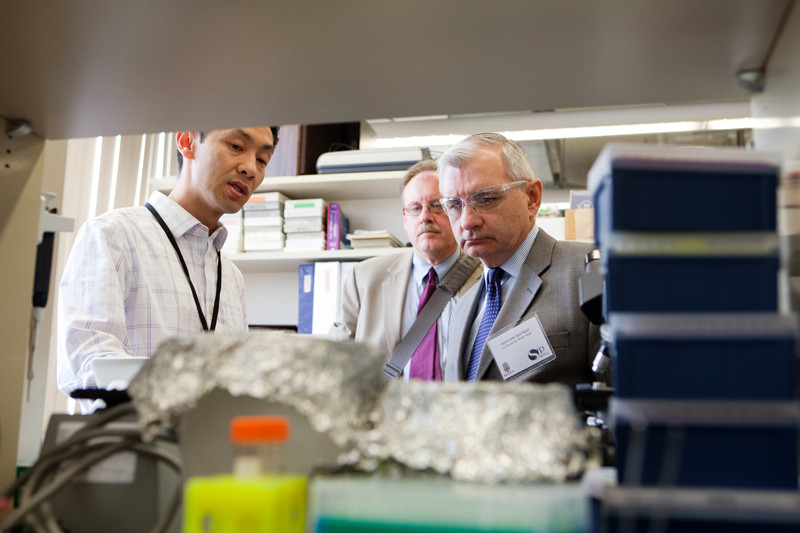
On April 9, Sen. Jack Reed, D-R.I., toured the facility – located in Providence’s Knowledge District – along with a group of federal and state officials to see first-hand some of its accomplishments in its Laboratories for Molecular Medicine.
Reed plays an important role in supporting the program. He serves as the chairman for the Senate Interior Appropriations subcommittee, which decides on funding for the Superfund program.
“We have a great legacy here in Rhode Island. We were the beginning of the Industrial Revolution, but over the centuries those processes have left a lot of contamination and serious questions of the effect on health,” he said. According to Reed, Rhode Island has 12 Superfund, or hazardous-waste sites, and over 300 Brownfield sites, abandoned industrial and commercial facilities available for redevelopment but are suspected of being environmentally contaminated, such as old textile mills.
The Brown Superfund Research Program explores a variety of pollutant concerns, such as noxious vapors, toxicity of nano-materials, human fertility and its relation to toxicity, and heavy-metals removal, to name only a few.
“This laboratory is at the forefront,” Reed said. “It is state-oriented; they are trying to deal with some serious problems in Rhode Island. It’s collaborative, spanning the health department, environmental management, and it also reaches back into the community. This is not just some esoteric, lofty enterprise that never touches ground, it’s engaged and involved.”
“It is critical to deal with the issue, not just what happened, but how to remediate it and how to put these properties back into useful, productive enterprise,” Reed said.
“We work on two fronts,” explained Kim Boekelheide, director of the program. “We work on understanding the concern around health effects and when to intervene and clean-up. Then we work on strategies for doing that cleanup in an efficient and safe manner.
“We translate the discoveries into practical applications that can be used by a commercial enterprise,” he said. He added the program also tries to stimulate or sponsor private companies in remediation projects, when the situation warrants.
Brown Provost Mark S. Schlissel said research programs like the university’s need consistent funding to be effective.
“If our commitment to understanding, mitigating and preventing degradation of the environment waxes and wanes with each economic cycle, we’re in big trouble,” he said.
Joining Reed on the tour was Gwen Collman, director of extramural research and training for the National Institute of Environmental Health Sciences, the organization that provides the funding.
“Rhode Island communities can use this laboratory as a technical assistance facility, to reach out to investigators and work in partnership,” Collman said. •