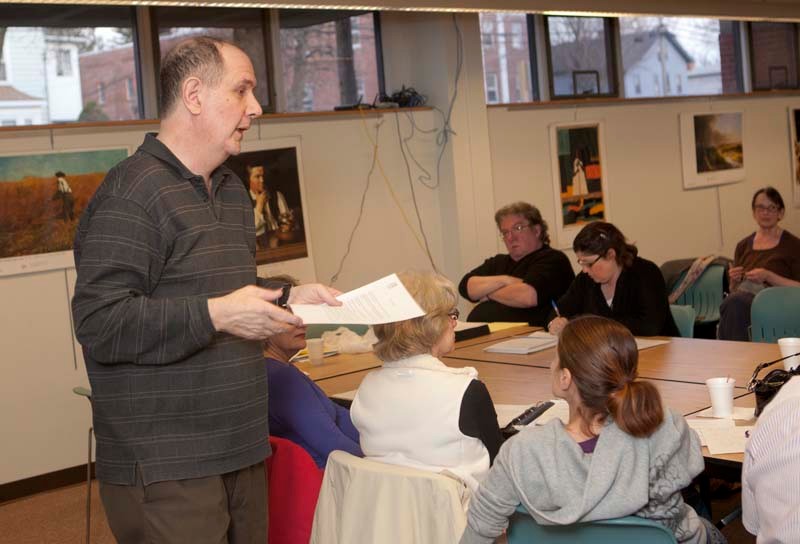
By day, Stephen A. Colella is a vocational-rehabilitation counselor at the University of Massachusetts Worcester. On Monday nights, however, he is a volunteer and the founder of Job Club RI, an all-volunteer, free series of classes designed to put people back to work.
Colella, of Warwick, is a defender of the middle class, a group he sees as the biggest victim of the Great Recession. Job Club members are generally skilled or semi-skilled and made about $30,000 when working. He says they have no recourse for help at the federal or state level because many of those training programs are designed for the economically disadvantaged, those living on the border of poverty.
Some of the unemployed are unfamiliar with the Internet or online searches and social media. They are unfamiliar with its possibilities or the concept that most employment opportunities are advertised online. He provides the fundamentals for the technical aspects like cover letters, resume development, job applications, interviewing techniques and understanding the job market. Members are given examples of resumes, interview questions and responses, job-search strategies, interviewing and networking. More importantly, he educates and rebuilds confidence.
The program, which started out as a support group, has helped about 56 percent of attendees, or 170 people, land jobs since the program’s inception in 2009, says Colella. And he’s done it with only limited donations, along with money from his own pocket.
The average participant at the club has been unemployed for 77 weeks, some less and some significantly more. The mission statement of the club can be summarized in one question posed by Colella to attendees of a Warwick meeting of the Smaller Business Association of New England on April 4: “Do you know what happens to a person who has been unemployed or underemployed for a long period of time?”
Many Job Club attendees have a steady work history, so suddenly having to find work is foreign terrain for them; resumes need updating, cover letters require certain buzzwords and with the tough job market, rejections are plentiful. “If you’re lucky, you might get an email saying your application was received. If you’re really lucky you’ll get a letter saying that you didn’t get the job but they’ll keep the letter on file.
For Colella it all can be reduced to the basics: dignity, respect, value and self-worth. “For the people that go through our program, they have been reduced or altogether lost,” he said. “What can I do individually to make a difference? Being a vocational councilor, I thought I could teach job-searching skills in an open format.”
Classes run Monday evenings in six-week sessions at the West Warwick Public Library. The public is invited to attend any class free of charge.
The club began in October 2009, hosted at no charge by the financially strapped library.
“The board of directors believed in us and our mission,” Colella said. “We are very grateful for their help.”
The feeling is mutual, according to West Warwick Public Library Director Brigitte Hopkins. “We’re extremely grateful that he chose our library to host the club. Steve is … committed to the program and the people,” she said. Hopkins says the club currently draws about 25 people from across the state for each class.
At the beginning the club started small. The first class had six attendees, three of whom soon received job offers. The library handled the publicity and only people in the immediate area attended. Colella’s hands-on approach got results, things were running smoothly and people were becoming employed again.
It was all taken to a different level last year, when local publicity generated some national attention. The publicity brought new attendees to the program but did nothing to help obtain resources, whether it be in the form of funding for expenses or assistance in employing people. Colella redoubled his efforts and began creating his own job bank.
“I asked what could be done by the community in order to bypass federal and state help. The answer was a community-based job bank,” he said.
Employers were asked to attend a club session and become involved. The response, he says, has been overwhelming. Companies such as Bank Rhode Island, Citizens Bank and CVS Caremark Corp. have helped with job leads and placement.
Bank Rhode Island has provided speakers for Job Club meetings and carries Job Club brochures in all 17 branch locations, said Alan P. Melidossian, vice president for marketing and product development at BankRI.
When asked why his program is successful, Colella brings it back to the basics.
“We forget the realities of being unemployed. A big amount of my time is to remind people that they do have some value and something to offer, they do have skills but no one has told them that in a very long time. They have to look at their resume and try to again become that person they once were. It can be very difficult,” he said. “One of the advantages in coming to the club is that they realize they are not alone.”
Job Club last year received one donation, for $3,000. This year, Colella estimates he’ll pay about $1,300 out of pocket for club expenses. He’s applying for nonprofit status.
Alan Barta, 60, has had a long career since graduating from college in the late 1970s. The Cranston resident spent the better part of his career as a technical writer until being laid off in 2004. Since then he has been self-employed, recently working a series of jobs in order to break even.
“Last year I spent six months exploring … and improving interviewing skills, which atrophy for lack of opportunities to use. I joined several networking clubs. I took a free course with Lynn Watterson at CCRI. Career Pathways and Job Club RI similarly concentrate on cover-letter writing, resumes and self-branding,” said Barta, who said he found renewed motivation through the weekly Job Club classes.
In March, Barta started a new position as a quality/regulatory writer for Johnson & Johnson, the global health manufacturer, under a long-term contract.
Ann Shugrue is another successful Job Club graduate.
She worked for Sallie Mae Student Loans for 25 years before she was laid off due to consolidation in March 2011. She turned to the Job Club. “I learned how to look for a job, what companies are looking for and interviewing techniques,” said the 57-year-old Cranston resident.
Since November she’s been with the Mergis Group, working for Citizens Bank as an accounting-specialist clerk. It’s been a bit of an adjustment, she said, but things are now going well.
“I received a lot of support from the Job Club,” she said. •