Researchers affiliated with Brown University and Tivorsan Pharmaceuticals Inc. in Providence are moving toward clinical trials of a treatment to combat Duchenne Muscular Dystrophy, the most common form of muscular dystrophy that kills males in young adulthood.
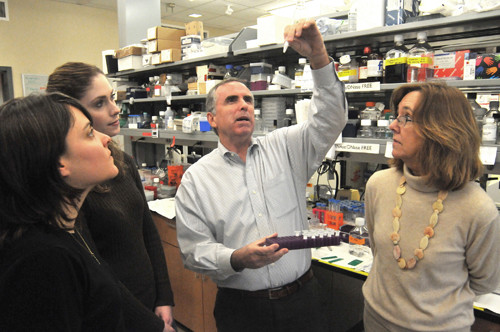
Justin Fallon, a professor of neuroscience at Brown since 1996 has been working 25 years on a possible cure for DMD and now, “we are entering the final stage of our development,” he told Providence Business News in a recent interview. “We’re encouraged with the progress we’ve made.”
“Encouraging developments are on the horizon,” predicted Dr. Joel B. Braunstein, acting CEO of Tivorsan Pharmaceuticals Inc., referring to what he called “intense interest” among researchers and drug companies across the country to identify an effective treatment for DMD with “a number of compounds” now being tested in various research arenas.
What Fallon and his seven-member research team are working on at Brown involves Biglycan, a human protein that can restore health to dystrophin-deprived muscles, reducing muscle degeneration and improving muscle function.
A recombinant, proprietary form of Biglycan has proven effective in treating mice with muscular dystrophy, Fallon said. Neither Fallon nor Braunstein could say when clinical trials on humans, which can last multiple years, might begin. “We are in preclinical development,” Braunstein said. “We are working to advance this program as quickly as possible.”
Duchenne Muscular Dystrophy is an inherited condition, caused by a mutation of genes that robs muscles of dystrophin. It affects approximately one in 3,500 newborn boys and is usually diagnosed at the age of 4 or 5 years old.
For a few years after diagnosis, the afflicted boys are “OK, they are really fine,” Fallon said.
Fallon said he became involved in DMD research in the 1980s, almost by happenstance. “When I started, I didn’t know I was working on muscular dystrophy,” he said. “I was just trying to understand how nerve cells communicate with muscle cells.” He was then doing post-doctoral work at Stanford University in California.
Fallon continued his research through the late 1980s and early 1990s at a laboratory he opened in Shrewsbury, Mass., coming to Brown in 1996. By then, he knew what he was working on could apply to muscular dystrophy and, with the 1996 identification of Biglycan, he was certain. “It really said to us that we may have a path for rescuing this defective complex of proteins,” he said.
The next five or so years were devoted to full-blown research of Biglycan, to better identify its functions. In the last five or so years, research has included tests on mice afflicted with muscular dystrophy and development of an actual drug that human patients could take, according to Fallon.
If successful with DMD, “there is good reason to believe” that Biglycan could be used to combat other forms of muscular dystrophy and perhaps amyotrophic lateral sclerosis (ALS), also known as Lou Gehrig’s disease, Fallon said. “That is our goal, we can’t guarantee it,” he said, adding that Tivorsan’s plans call for testing at the end of next year to see if the protein can be used against other muscular diseases.
Braunstein and Fallon agreed that the solution may very well involve two “complementary” drugs taken together. “That is a likely scenario,” Fallon said, adding that “this kind of therapy” often requires a combination of treatments.
Tivorsan was scheduled to present Fallon’s findings at Windhover’s sixth annual Therapeutic Area Partnerships conference Nov. 30- Dec. 2 in Boston. Windhover, a national provider of business news in the life sciences industry, in October named Biglycan one of its “Top 10 Most Interesting ‘Hot Space’ Projects to Watch” in 2011.
Financial support for Fallon’s research is coming from a number of places, including: federal sources such as the National Institutes of Health, which in 2009 awarded Fallon a multiyear grant of $5 million; the DMD-focused philanthropies of Charley’s Fund, Parent Project Muscular Dystrophy and the Nash Avery Foundation. Fallon formed Tivorsan in collaboration with colleagues from Old Forge Holdings in Greenwich, Conn., and LifeTech Research in Baltimore.
The company does not have a physical presence in Providence yet, but plans to have one soon and is leveraging ongoing research based at Fallon’s lab at Brown. •