If there’s one thing Rhode Islanders should be familiar with by now, it’s the fine print on their homeowner-insurance policy.
For the last three years residents of the state have felt the brunt of nature’s fury. In 2010 there were historic spring floods. Last year was the damage of Tropical Storm Irene, and this year the power of Sandy.
In the case of Sandy, it has already been announced that hurricane deductibles are not applicable in the states of Rhode Island, Connecticut, Delaware, Pennsylvania, the District of Columbia, Maryland, and even in New York and New Jersey. That’s because the National Hurricane Center and the National Weather Service did not issue a hurricane warning for these states, or hurricane-force winds were not sustained at landfall, depending on the state and the policy.
The net effect is that in cases strictly involving wind damage not related to declared hurricanes, the consumer generally makes out better.
“If we are hit by a hurricane and it’s declared a hurricane, there are deductibles built into the policies that the home or business owner has to take more of the loss out of their pocket,” said Mark A. Male, executive vice president, secretary and treasurer of the Independent Insurance Agents of Rhode Island. “For example, if the standard deductable on a homeowner’s policy is a flat $500, but in a hurricane situation the deductable can be a percentage of, say, 2 percent, it works out to $4,000 on a $200,000 policy.”
Male said that hurricane deductibles could be a flat fee but that generally isn’t the case; most deductibles are either 1, 2 or 5 percent. Per Rhode Island law, the deductable for a homeowner cannot exceed 5 percent.
Such may not be the case for a commercial business. “Laws in Rhode Island provide for residential policies, specifically homeowner policies, which can have a hurricane deductible that is almost higher than one in the standard policy,” Male said.
Businesses, however, have no such restriction. They could have a wind-storm deductable, a named-storm deductible or a host of other variations on their policy, and there is no state regulation for insurance companies with commercial accounts to limit the deductible. Both the policy and deductible are controlled by what the insurer offers and what option the business chooses, thus the calculated gamble between premium versus deductible is weighed.
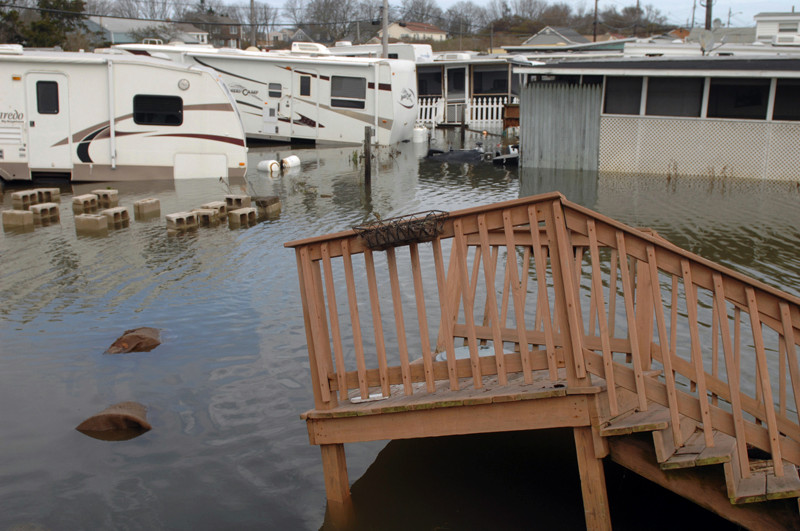
As a practical matter, insurance adjusters could see a house with its roof peeled back and windows smashed and pay for the adjustment, including the rain damage. But if the same property is off its foundation due to an obvious storm surge, that damage is not covered unless the homeowner has a flood-insurance policy.
The good news is that for residents taking on a beachside mortgage, the lender requires flood insurance if the property is within the Federal Emergency Management Agency flood plain. However, should they own their property outright, coverage is up to the owner and the calculated gamble begins.
Gary D. Mansfield, vice president of Mansfield Insurance in Westerly, has accounts from Charlestown to Stonington, Conn. He and his staff have been working nonstop to help their clients. “There were a lot of people that had to deal with storm damage, power outages and food spoilage, things of that nature. It was worse in Misquamicut, where even the homeowners were not let back in the area until 2 p.m. Friday, four days later.”
The damage was so extensive that adjusters couldn’t access the area, for the most part, until the week beginning Nov. 5.
Mansfield, like Male, could not speculate on the percentage of owners who own their property outright but did not have flood insurance. “We only see our claims and generally those are cases where flood insurance was required,” he said.
But some lessons are hard to learn.
In the spring floods of 2010, homeowners with feet of water in their basement due to rising rivers and ponds learned that their usual policy did not cover the flooding. Mansfield started a campaign to address this, explaining the different coverages and urging clients to revisit flood insurance.
The response was limited. “We had a 2 percent response,” Mansfield said. “They don’t expect to see a 200-year storm again.” Even Tropical Storm Irene didn’t result in an uptick in flood insurance.
“There is only so much that people can afford and that [has them] definitely making some difficult decisions,” he said. •